
Ronda Medical
OrthoPediatrics

Free Gliding SCFE Screw (telescopic screw)

A two-part, cannulated telescopic screw for fixation of slipped capital femoral epiphysis (SCFE) — it lengthens with growth, allowing the femoral neck to grow.

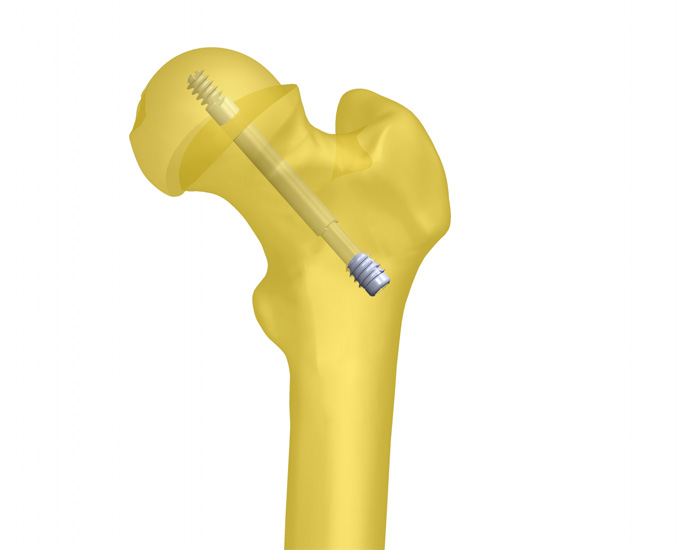
The Free Gliding SCFE Screw positioned at the femoral head and neck (3D model)
Ø6.5 / 7.3 mmDiameters
48–58 mmMini
60–102 mmStandard
TrilobeDesign
Clinical description

The Free Gliding SCFE Screw is a two-part, cannulated telescopic screw developed by Pega Medical (an OrthoPediatrics group company) for the treatment of slipped capital femoral epiphysis (SCFE) — the most common hip condition in the growing child. The system consists of a female component, with a proximal thread located entirely within the epiphysis, and a male component that telescopes inside the female component and anchors in the lateral cortex.

Unlike standard screws, the “free gliding” design allows the implant to lengthen with growth, without compression and without premature closure of the growth plate (physis). As a result, the femoral neck can continue to grow, and the literature describes remodeling of cam-type deformity at the femoral neck.

Proximal and distal threaded fixation provides stability, while the trilobe design confers rotational stability, without requiring prominent screw placement. The system is intended for children with open growth plates, to halt or prevent slippage (therapeutic or prophylactic fixation).

Indications
  • Fixation of slipped capital femoral epiphysis (SCFE) in children with open growth plates.
  • Prophylactic hip fixation, when indicated.
  • Maintaining femoral neck growth during fixation.
Key features

“Free gliding” design

Lengthens with growth, without compression and without premature physeal closure.

Allows neck growth

The femoral neck continues to grow; the literature describes remodeling of cam-type deformity.

Rotational stability

Trilobe design and proximal and distal threaded fixation for stability.

Therapeutic or prophylactic

To halt or prevent slippage in children with open growth plates.

Product gallery
The Free Gliding SCFE Screw positioned at the femoral head and neck (3D model)
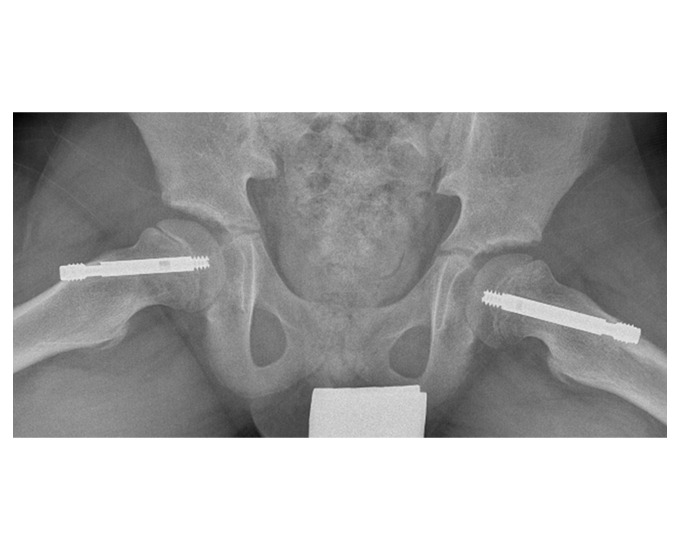
Radiograph: bilateral hip fixation with the Free Gliding SCFE Screw
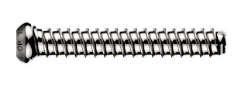
Free Gliding SCFE cannulated screw (render)
Technical specifications
Type
Two-part cannulated telescopic screw (female + male)
Available diameters
Ø6.5 mm · Ø7.3 mm
Lengths
Mini: 48–58 mm · Standard: 60–102 mm
Fixation
Proximal and distal thread; trilobe design (rotational stability)
Principle
Lengthening (“free gliding”) without compression, without premature physeal closure
Technique
Cannulated, over a guide wire (5.0 / 6.5 / 7.3 mm reamers)
Clinical evidence

A selection of publications and studies that mention use of the system. Summaries are indicative; for details, consult the original source.

Femoral neck growth and remodeling with “free-gliding” screw fixation in SCFE

Paley Orthopedic & Spine Institute și colab. · Journal of Pediatric Orthopaedics, 2021

A study comparing hip growth and remodeling over the first two postoperative years between the free-gliding (FG) screw and standard screws in stable SCFE. FG screws allowed better remodeling of cam-type femoral neck deformity and continued growth of prophylactically treated hips, whereas standard screws favored neck shortening (coxa breva).

In FG hips, the alpha angle remodeled by 12.9° in the first postoperative year (p = 0.018).
View source
Certifications & compliance
CE marking

Would you like information about Free Gliding SCFE Screw (telescopic screw)?

The Ronda Medical team provides details about availability, configurations, and technical support.

Contact the team